




 Brad Sugars: Transforming Entrepreneurship Through Proven Systems, Business Growth, and Financial Freedom
Home»Business»Miami Cargo Crash Highlights the Operational Risks of America’s Logist…
Miami Cargo Crash Highlights the Operational Risks of America’s Logistics Infrastructure
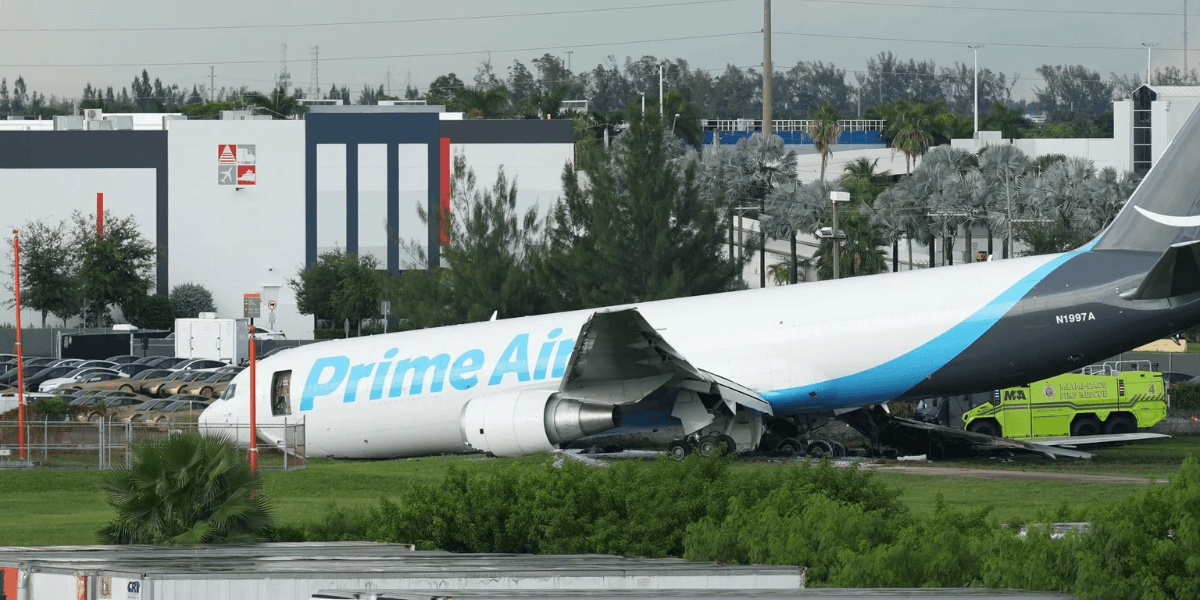
An Amazon Prime Air cargo aircraft overran a runway at Miami International Airport on Sunday, temporarily shutting down one of the country's important aviation gateways and demonstrating how a single transportation disruption can ripple across modern business and logistics networks.
The Boeing 767-300, operated by 21 Air as Prime Air Flight 7598, arrived from San Juan, Puerto Rico, before overrunning a runway at approximately 2 p.m. local time. The aircraft struck multiple vehicles and caught fire, prompting a response involving more than 60 Miami-Dade Fire Rescue units.
The Federal Aviation Administration subsequently imposed a ground stop at Miami International Airport, while all runways and taxiways were closed as emergency crews responded and officials assessed the scene.
A Business Infrastructure Disruption
For businesses, the significance of the incident extends beyond aviation safety.
Miami International Airport functions as a major transportation and logistics hub, particularly for connections involving the Caribbean and Latin America. Cargo aircraft operating through the airport form part of a broader supply chain that links manufacturers, distributors, retailers and consumers.
The temporary closure therefore affected more than passengers. Cargo movements, aircraft scheduling, ground transportation and delivery operations also faced disruption.
The incident involved an Amazon-branded aircraft, giving the crash an additional connection to one of the world's largest logistics businesses. Amazon's Prime Air network is designed to move goods through an increasingly sophisticated combination of aircraft, fulfillment facilities, transportation infrastructure and last-mile delivery systems.
When a major node becomes unavailable, businesses can face delays even when the original disruption involves only one aircraft.
Investigators Begin Their Work
The FAA said it would investigate the crash, while the National Transportation Safety Board began gathering information. Those investigations are intended to establish the facts surrounding the runway overrun rather than assign conclusions prematurely.
The aircraft had departed San Juan before arriving in Miami. Officials identified it as a Boeing 767-300, a type widely used in cargo operations.
Investigators will examine operational and technical evidence as they reconstruct the flight. Until that work is complete, the precise cause of the runway overrun remains undetermined.
Amazon spokesperson Kelly Nantel said the company was working with local authorities and officials to understand what occurred while prioritizing the safety and well-being of those involved.
Resilience Becomes a Strategic Issue
The disruption underscores a broader business challenge: companies increasingly depend on tightly connected transportation systems that can create efficiency but also introduce vulnerabilities.
Modern logistics operations frequently rely on precise scheduling. Aircraft arrivals, warehouse processing, trucking connections and customer delivery commitments can depend on one another. A major airport closure can therefore produce secondary effects throughout a supply chain.
The Miami incident provides a visible example of why businesses maintain contingency plans for transportation interruptions. Diversion capabilities, alternative airports, inventory buffers and flexible routing can become important when a key logistics facility is temporarily unavailable.
The disruption also illustrates the importance of infrastructure resilience for companies operating across multiple markets.
What Comes Next
The immediate priority remains emergency response and aviation safety. Airport authorities must assess the affected area, while federal investigators work to determine the circumstances of the accident.
The business implications will depend partly on how quickly normal operations can resume and whether additional restrictions remain necessary.
For companies dependent on air cargo, the incident is a reminder that logistics performance depends not only on corporate systems but also on public infrastructure.
The Miami crash therefore carries significance beyond the aircraft involved. It highlights the intersection of aviation safety, supply-chain resilience and business continuity at a time when companies increasingly depend on rapid movement of goods across borders.

Leadr Magazine Contributor
Abigail Rhodes
Covers entrepreneurship, innovation, and career development, sharing stories about ambitious professionals and growing businesses.
This article features partner, contributor, or branded content from a third party. Members of the Leadr Magazine editorial staff were not involved in the creation of this content. All views and opinions are those of the contributor alone.
Related Posts
Brad Sugars: Transforming Entrepreneurship Through Proven Systems, Business Growth, and Financial Freedom Castaways Bistro: Punta Cana Paradise
 The Revenue Hiding in Your Business Back End