


 Shabnum Bi Named Entrepreneur of the Year 2025
Home»Leadership»The Path Isn’t Found. It’s Forged: How Pascal Xavier Reinvented Himsel…
The Path Isn’t Found. It’s Forged: How Pascal Xavier Reinvented Himself Across Functions, Industries, And Countries

Pascal Xavier shares how adaptability, resilience, and human value shape career success in a disruptive world.
There was no master plan.
No carefully mapped career ladder. No singular profession pursued from graduation to future retirement. Instead, Pascal Xavier’s journey has been defined by something increasingly valuable in today’s world: the ability to adapt.
Over more than three decades, Pascal has moved through industries, countries, functions, and leadership roles with a consistency that might seem unusual on paper but has become remarkably relevant in an era of accelerating change. Today, as Founder and Principal Consultant of GRC Advocates, Chief Risk Officer in a highly regulated environment, author, speaker, educator, and advisor, he has become known not for mastering a single profession, but for mastering reinvention itself.
“The path isn’t found. It’s forged,” Pascal says.
That philosophy has guided a career spanning engineering, defense research and development, semiconductor manufacturing, mining and construction, professional services, astronomy, entertainment and hospitality, healthcare and disability services, governance, risk management, compliance, consulting, higher education, and executive leadership.
For many professionals, changing industries once can feel daunting. Pascal has done it repeatedly.
A Career Built On Adaptability
What makes Pascal’s story compelling is not simply the breadth of his experience. It is the reality that many of those transitions were born from disruption.
Throughout his career, he has navigated restructures, redundancies, international relocations, technological shifts, and changing market conditions. Rather than viewing disruption as an obstacle, he began studying it as a recurring feature of modern professional life.
That perspective eventually became the foundation of his book, The Future of Careers: How to Adapt and Thrive in a Disruptive Age.
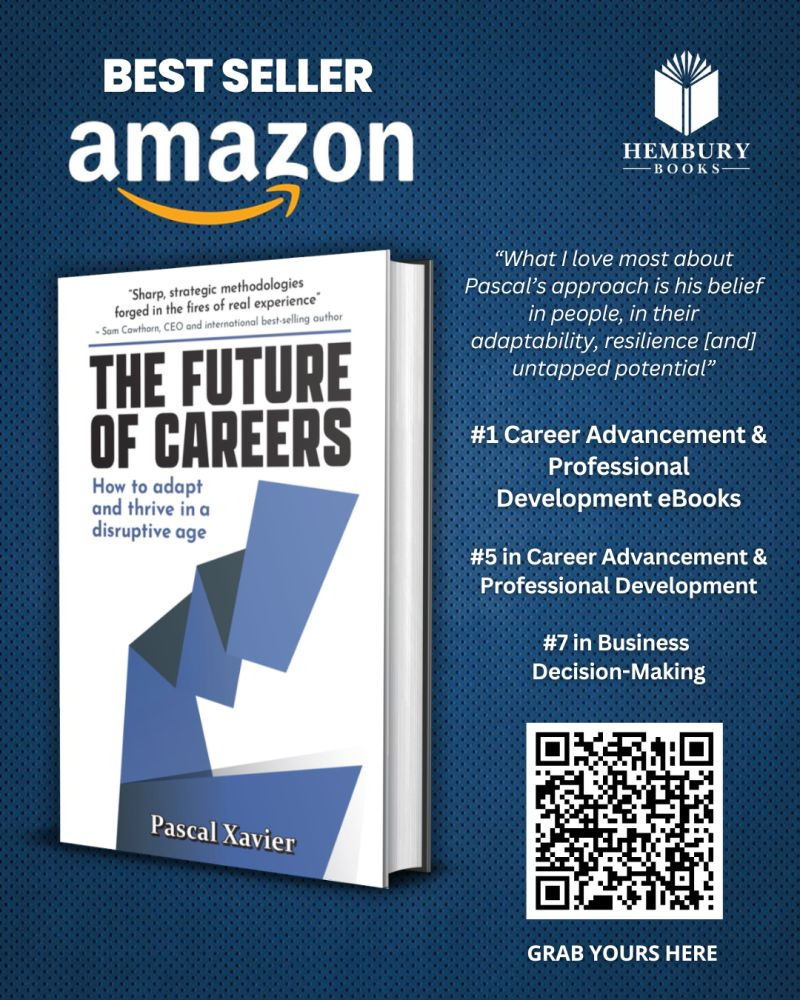
Drawing from lived experience rather than theory alone, Pascal developed practical frameworks designed to help individuals and organizations navigate uncertainty. His work challenges the traditional assumption that careers should follow predictable, linear paths.
“Careers no longer require ladders,” he explains. “They require navigation systems.”
The message resonates because it reflects a reality millions of professionals now face. Industries evolve. Roles disappear. Technologies transform expectations. Success increasingly belongs to those who can adapt rather than those who cling to certainty.
Beyond The AI Headlines
Much of today’s conversation about the future of work centers on Artificial Intelligence.
While Pascal acknowledges its significance, he believes the narrative is often too narrow.
His research and advisory work focus on a broader phenomenon he calls “Concruption” a term describing the reality that multiple disruptions often occur simultaneously or in close succession.
Artificial Intelligence may be one factor. Economic uncertainty, demographic shifts, workforce transformation, geopolitical instability, personal life challenges, globalization changes, and regulatory pressures frequently occur at the same time.
Organizations and individuals rarely experience disruption in isolation.
By viewing change through this wider lens, Pascal helps leaders move beyond simplistic forecasts and focus instead on building resilience.
“The leaders who succeed won’t be those who predict the future perfectly,” he says. “They’ll be those who adapt fastest when the future surprises them.”
From Executive Leadership To Thought Leadership
Pascal’s ability to bridge disciplines is one reason his perspective stands apart.
His career includes executive leadership positions, consulting engagements, governance advisory roles, teaching appointments, and professional speaking engagements. He currently serves as an Honorary Fellow and Program Advisory Board member at the University of Technology Sydney while continuing to advise boards and senior executives on governance, risk, and compliance matters.
He is also a Fellow of the Governance Institute of Australia, a distinction recognizing significant expertise and contribution within the governance profession.
Yet despite his academic credentials, Pascal remains firmly focused on practical application.
His frameworks emerged from real decisions, real setbacks, and real career transitions.
Among them are S.T.E.P.S., a model describing five distinct modes of career mobility; P.I.V.O.T., a framework for navigating movement across industries, functions, and geographic regions; and The Glass Is Cleaner on the Other Side, which challenges assumptions professionals often make before major career decisions.
Rather than offering generic career advice, these frameworks seek to provide structured ways of thinking about change.
What Makes Humans Valuable?
At the center of Pascal’s current work lies a question increasingly relevant to organizations and professionals alike:
What makes humans valuable when machines become smarter?
His answer is not technical. It is deeply human.
While technology continues to transform tasks and processes, Pascal argues that uniquely human capabilities become more important, not less.
Judgment. Ethics. Context. Creativity. Strategic thinking. Relationship building. Adaptability. Resilience.
These qualities have defined his own career and now form the foundation of his consulting, speaking, and thought leadership work.
“Technology changes what we do,” Pascal says. “It doesn’t change why humans matter.”
It is a message that resonates with executives grappling with digital transformation as much as professionals seeking career security.
Reinvention As A Competitive Advantage
Many experts spend decades developing expertise within a single field.
Pascal’s expertise emerged from moving between fields.
That distinction gives him a unique vantage point on modern work.
His story is not one of uninterrupted success. It is a story of repeatedly starting over, learning new industries, acquiring new capabilities, and finding relevance in changing environments.
Perhaps that is why his message feels timely.
In a world where disruption is becoming the norm rather than the exception, reinvention is no longer an occasional necessity. It is a professional capability.
“Your greatest career asset is not what you know today,” Pascal says. “It’s how quickly you can become valuable tomorrow.”
Forging The Future Through Adaptability
As organizations confront technological change and professionals reconsider what career success looks like, Pascal’s journey offers a practical lesson.
The future cannot be controlled. It can only be navigated.
For more insights on career adaptability, leadership, governance, and thriving through disruption, readers can explore Pascal Xavier’s work through his website, connect with him professionally via LinkedIn, or learn more about his programs and speaking engagements.
In a rapidly changing world, Pascal Xavier’s message remains both simple and powerful: success belongs not to those who perfectly predict the future, but to those who continually learn how to adapt when it arrives.

Leadr Magazine Contributor
Ashley Franklin
Covers entrepreneurship, branding, leadership, and emerging companies.
This article features partner, contributor, or branded content from a third party. Members of the Leadr Magazine editorial staff were not involved in the creation of this content. All views and opinions are those of the contributor alone.
Related Posts
Shabnum Bi Named Entrepreneur of the Year 2025 Lee A. Wright Turns Faith Into A Life Of Purpose
 David Wortley Brings AI Warning To Oxford World Leaders