


 Faraday Future Expands Into Robotics With Nine New AI Devices and Four Industry Solutions
Home»Business»Faraday Future Expands Into Robotics With Nine New AI Devices and Four…
Faraday Future Expands Into Robotics With Nine New AI Devices and Four Industry Solutions
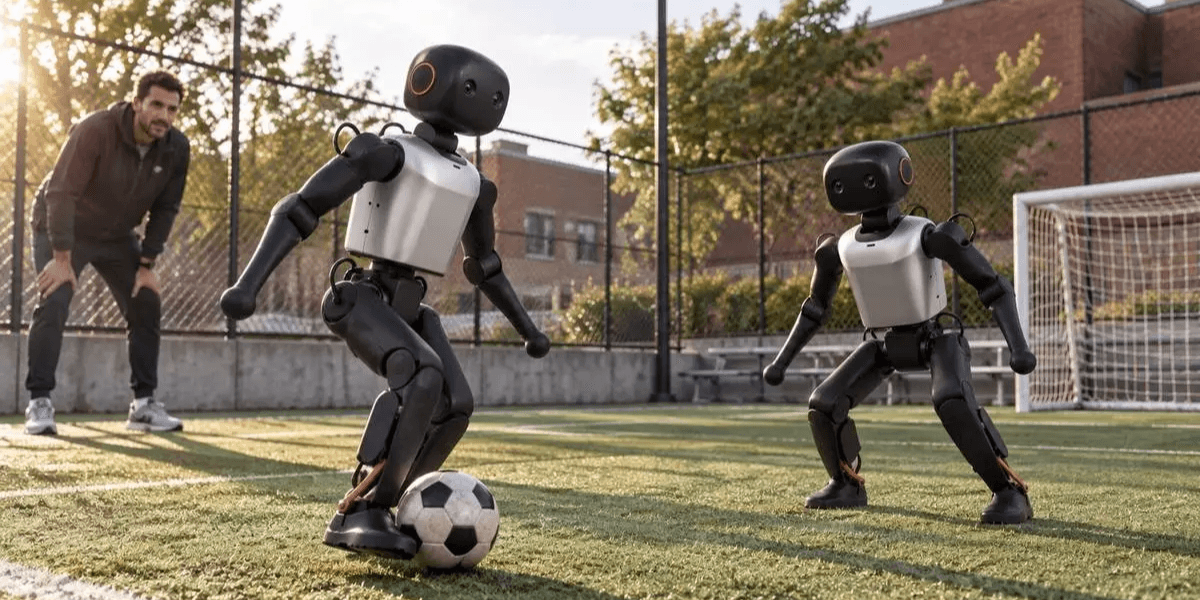
Faraday Future unveiled nine new embodied-AI robot configurations and four industry solutions as the California company expands its technology strategy beyond electric vehicles.
Faraday Future Unveils Robotics Portfolio
Faraday Future Intelligent Electric held its annual 919 launch event in California, unveiling a broader portfolio of artificial-intelligence-powered robotics products and industry solutions.
The company introduced nine new embodied-AI device configurations across five models, along with four industry productivity solutions designed for education, research, security and inspection.
The launch represents a significant expansion of Faraday Future's business strategy as the company develops technologies that combine artificial intelligence with physical machines.
The products include humanoid and wheel-legged robotic systems designed for different sizes and applications. The company also introduced solutions intended to move beyond individual robotic devices toward more complete systems for organizations.
From Devices to Industry Solutions
Faraday Future's launch divided its robotics strategy into devices and industry productivity solutions.
The device portfolio included the FF All-New Futurist, FF Master Mini, FX Aegis Hyper, FX Aegis Mega and FX Aegis Classic Ultra-W.
The four industry solutions focused on K-12 education, research, security and inspection.
That distinction is important from a business perspective because industrial customers often require more than hardware. Companies adopting robotics may also need software, deployment systems, maintenance capabilities and specialized applications.
By presenting complete industry solutions alongside hardware, Faraday Future is positioning its robotics business around practical deployment rather than only individual machines.
Artificial Intelligence Moves Into Physical Systems
The company's strategy reflects a broader technology trend in which artificial intelligence is increasingly being integrated into physical machines.
Traditional AI applications primarily operate through software, cloud computing and digital interfaces. Embodied AI extends those capabilities into robots that can interact with physical environments.
Such systems can potentially be used for tasks involving inspection, security, education, research and industrial operations.
The technology also requires different engineering capabilities from conventional software AI because robots must combine computing with sensors, movement systems, mechanical components and physical safety requirements.
Faraday Future's product launch demonstrates how companies are attempting to build businesses around that intersection.
Industrial Applications Take Priority
The four productivity solutions announced during the event focused on identifiable institutional applications.
Education systems can use robotics for instruction and research, while industrial organizations can use robotic systems for inspection and security-related activities.
The company also highlighted its participation in the International Manufacturing Technology Show in Chicago, where its Aegis robotic systems were demonstrated for industrial applications.
That activity places the robotics initiative within a broader manufacturing and automation market.
For businesses, the central issue is whether robotic technology can be integrated into existing workflows and deliver measurable operational value.
A Broader Technology Strategy
Faraday Future's robotics initiative represents an expansion beyond its earlier identity as an electric-vehicle company.
The company describes its newer strategy as an embodied-AI ecosystem built around several connected components, including an AI brain and developer platform, robotic devices, industry productivity solutions and data capabilities.
Such an approach reflects an increasingly common technology-industry strategy in which companies seek to build platforms rather than individual products.
A platform can allow hardware, software and applications to operate together while providing customers with multiple ways to adopt the technology.
Business Implications
The launch also highlights the competitive nature of the emerging robotics market.
Companies developing humanoid robots, quadrupeds and mobile systems are competing to demonstrate useful commercial applications.
The market remains in an evolving stage, with businesses experimenting with different hardware configurations and use cases.
For customers, the practical questions include reliability, operating costs, integration requirements, workforce implications and the availability of technical support.
For technology companies, those considerations determine whether an impressive demonstration can become a sustainable commercial product.
Robotics Enters a New Phase
Faraday Future's September launch illustrates the continuing movement of AI from digital environments into physical systems.
The introduction of nine device configurations and four industry solutions gives the company a broader robotics portfolio and places greater emphasis on commercial applications.
The significance of the announcement lies in that transition from concept-driven AI demonstrations toward products designed for specific environments.
As companies across manufacturing, education, research and security examine the potential uses of robotics, the ability to provide complete systems may become increasingly important.
Faraday Future's latest launch places the company within that evolving market and signals a broader attempt to build a business around artificial intelligence, robotics and physical-world applications.

Leadr Magazine Contributor
Abigail Rhodes
Covers entrepreneurship, innovation, and career development, sharing stories about ambitious professionals and growing businesses.
This article features partner, contributor, or branded content from a third party. Members of the Leadr Magazine editorial staff were not involved in the creation of this content. All views and opinions are those of the contributor alone.
Related Posts
Faraday Future Expands Into Robotics With Nine New AI Devices and Four Industry Solutions Technology Stocks Drive Market Rebound Following Federal Reserve Rate Increase
 USGRCA: Dedicated Partners in Federal Contracting